
Why Understanding Your Dog’s Body Language Around Children Is Crucial
Dogs and children can develop wonderful, meaningful relationships, but only when adults take responsibility for ensuring safety on both sides. One of the most important and often overlooked aspects of dog safety around children is understanding canine body language.
Many dog bites involving children are preventable.
In most cases, dogs give multiple warning signals long before a bite occurs. The issue is not that dogs “bite without warning,” but that their communication is misunderstood, ignored, or misinterpreted, especially in busy family environments.
Learning how dogs express emotions such as stress, fear and discomfort are key. In addition, having a good understanding of the Ladder of Communication is essential for preventing incidents and creating safe, respectful interactions between dogs and children.
Why dogs and children require extra supervision
Children naturally behave in ways that can be stressful for dogs. From a canine perspective, children often:
-
Move unpredictably
-
Invade personal space
-
Hug tightly or grab
-
Make loud noises
-
Stare directly into faces
Even well-socialised, gentle dogs have their limits. When those limits are crossed repeatedly without relief, dogs may escalate their behaviour to protect themselves.
This is why understanding dog body language around children is not optional, it is critical.
How dogs communicate: Understanding canine body language
Dogs rely almost entirely on body language to communicate. They do not growl or snap as a first action. Instead, they begin with subtle signals designed to reduce conflict and de-escalate situations.
When these early signs are missed, dogs may feel forced to escalate. This progression is commonly referred to as the Ladder of Communication or the Steps of Fear.
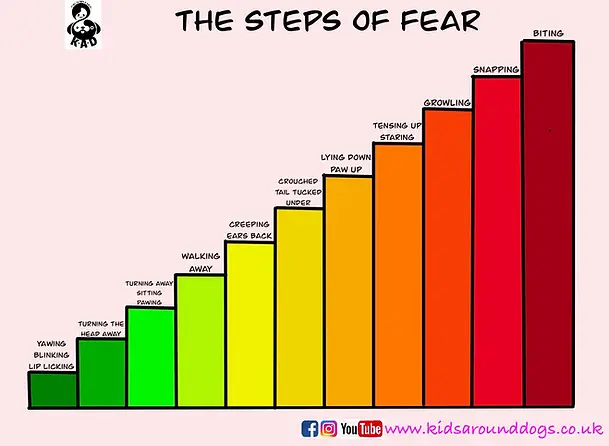
The Ladder of Communication: How dogs escalate when signals are ignored
The Ladder of Communication describes the predictable steps a dog may take when feeling uncomfortable or threatened. Most dogs move through these stages gradually, not suddenly.
1. Stress signals and calming behaviours
These early warning signs are frequently overlooked.
Common stress signals include:
-
Lip licking or tongue flicking.
-
Yawning when not tired.
-
Turning the head or body away.
-
Avoiding eye contact.
-
Freezing momentarily.
-
Lifting a paw.
Around children, these signals often appear during hugging, leaning over the dog, or crowding their space.
2. Avoidance and distance-creating behaviours
When stress signals are ineffective, dogs attempt to remove themselves from the situation.
Examples include:
-
Walking away
-
Hiding behind furniture
-
Moving to a crate or bed
-
Seeking an adult for support
When a child follows or corners a dog attempting to escape, the dog may feel trapped.
3. Warning signals
If avoidance fails, dogs escalate to clearer warnings.
These may include:
-
Stiff or tense body posture
-
Hard eye contact or “whale eye”
-
Growling
-
Showing teeth
-
Air snapping
Growling is a form of communication not aggression. Punishing a dog for growling often suppresses warnings, increasing the risk of a bite. If your dog is growling, it is important to understand why.
4. Bite
A bite is typically a last resort, occurring when the dog feels it has no other option. Many bites to children happen at close range and involve the face or hands.
Key dog body language parents should recognise
Signs of a Relaxed Dog
Safe interactions are more likely when a dog displays:
-
Loose, wiggly body movement
-
Soft eyes
-
Relaxed facial expression
-
Gently wagging tail at mid-height
Signs of stress or discomfort
Red flags that require immediate intervention include:
-
Stiff or frozen posture
-
Ears pinned back
-
Tail tucked or held rigidly
-
Excessive panting
-
Whites of the eyes showing
-
Licking lips and yawning
If these signs are present, the interaction should stop immediately.


Teaching children how to interact safely with dogs
Infants and Toddlers
-
Never allow unsupervised interaction.
-
Prevent hugging, climbing, or face-to-face contact.
-
Use baby gates and physical barriers.
-
Teach “hands to self”.
Older Children
-
Teach consent: the dog chooses interaction.
-
Respect when a dog walks away.
-
Never disturb dogs while eating, sleeping, or chewing.
Management is responsible dog ownership
Using management strategies does not mean a dog is unsafe, it means adults are proactive.
Effective management includes:
-
Providing dogs with safe, child-free spaces
-
Limiting interaction time
-
Clear household rules
-
Consistent adult supervision
These steps reduce stress, protect children, and prevent dogs from being pushed beyond their limits.
Understanding dog body language prevents bites
Most dog bites involving children are preventable. By learning to recognise canine stress signals and respecting what dogs communicate, families can significantly reduce risk and build safer relationships.
Dogs deserve to be understood.
Children deserve to be protected.
Adults are responsible for both.
Final thoughts
Dog bites do not happen without warning.
Stress signals are communication.
Understanding your dog’s body language around children is essential, not optional.
I work with nurseries, primary schools, secondary schools, and specialist schools across Surrey to deliver engaging, age-appropriate sessions that teach children about safety around dogs and how best to engage with them. You can read more about it by clicking the button below.
Written by
Katie Brill – CSAT / PACT-KSA / ABTC-ATI / KAD-AP
Separation Anxiety Specialist, Dog Training Instructor & School Dog Specialist
11th June 2026